
Cave Paintings of The Sky Gods
Jason Cousineau and Eric Renderking Fisk | March 9th, 2021
In this Paranormal Post edition of The Fedora Chronicles Radio Show, Jason Cousineau and Eric Renderking Fisk discuss an American Airlines passenger jet's Close Encounter of The Second Kind in the Stratosphere. The University Of Copenhagen's study proves our galaxy is teeming with Earth-Like Worlds thanks to the pebble accretion model for the formation of the terrestrial planets. Black Holes help astronomers here on Earth find Dark Matter.
In the second half of the show, Jay and Eric discuss the Creative Evolution article, "A 5000-Year-Old Aboriginal Cave Painting of The "Wandjina." Known As 'The Sky Beings'," and ARCHAEOLOGY WORLD's "10,000 Year Old Rock Paintings Depicting Aliens And UFOs Found in India," and the possible connection between the two that might depict reoccurring global catastrophes.
Subscribe to The Fedora Chronicles Stitcher, Spotify, Overcast, SoundCloud, iTunes, and PlayerFM
You can support the show by visiting our Zazzle page - exactly 12.5 percent of every purchase goes to keeping this and other shows on The Fedora Chronicles Network on the air. Coming soon we will have our new line of “Modern Fashion Is Evil” line of shirts, coffee mugs, and other swag.
Or, become a Patreon – click the Patreon link and for a mere dollar a month you’ll get early access to the podcasts, updates on what we’re working on, and so much more. Thanks for all your support in advance, and thank you to our listeners who have already contributed. With that said – Thanks for listening, enjoy the show!
Show Notes and Links
According to a new study from the University of Copenhagen, Earth, Venus, and Mars were created from small dust particles containing ice and carbon. The discovery opens up the possibility that the Milky Way may be filled with aquatic planets.
Astronomers have long been looking into the vast universe in hopes of discovering alien civilizations. But for a planet to have life, liquid water must be present. The chances of that finding scenario have seemed impossible to calculate because it has been the assumption that planets like Earth get their water by chance if a large, ice asteroid hits the planet.
Science Advances: "A pebble accretion model for the formation of the terrestrial planets in the Solar System," February 17th, 2021
Pebbles of millimeter sizes are abundant in protoplanetary discs around young stars. Chondrules inside primitive meteorites—formed by melting of dust aggregate pebbles or in impacts between planetesimals—have similar sizes. The role of pebble accretion for terrestrial planet formation is nevertheless unclear. Here, we present a model where inward-drifting pebbles feed the growth of terrestrial planets. The masses and orbits of Venus, Earth, Theia (which later collided with Earth to form the Moon), and Mars are all consistent with pebble accretion onto protoplanets that formed around Mars’ orbit and migrated to their final positions while growing. The isotopic compositions of Earth and Mars are matched qualitatively by accretion of two generations of pebbles, carrying distinct isotopic signatures. Last, we show that the water and carbon budget of Earth can be delivered by pebbles from the early generation before the gas envelope became hot enough to vaporize volatiles.
AT FIRST, YUANMING Wang was not excited. More relieved, maybe. The first -year astrophysics PhD student at the University of Sydney sat in front of her computer, looking at images in which she’d found the signs of radio waves from distant galaxies twinkling, just as she had hoped. But because Wang’s discovery relied more on scouring ones and zeros than peering through a telescope—and the discovery itself was just plain weird—it took awhile for the moment to hit.
Radio wave “twinkling,” known as scintillation, happens when the radio signals from sources like stars and black holes get interrupted as they stream toward Earth. Detecting scintillation from distant galaxies is very rare. Only a tiny fraction of the night sky will yield these signals, and most telescopes are unable to capture variations on such fast timescales. But Wang found hallmarks of scintillation from six galaxies at once. And five appeared to be separate galaxies in a tight, straight line. "I realized, OK, so this is the first detection of such an unusual shape in the sky," Wang says. “That is definitely the first time, and it will imply we found some invisible thing. So at that moment I started to understand this exciting result.”
What excited Wang’s team wasn’t actually the radio waves, each beaming in from billions of light-years away. It’s what was blocking them, making the signals momentarily flicker. They believe it’s an invisible cloud of cold gas, right in our galactic backyard, and that clouds like it may answer a long-standing puzzle about why more than half of the Milky Way’s matter is AWOL.
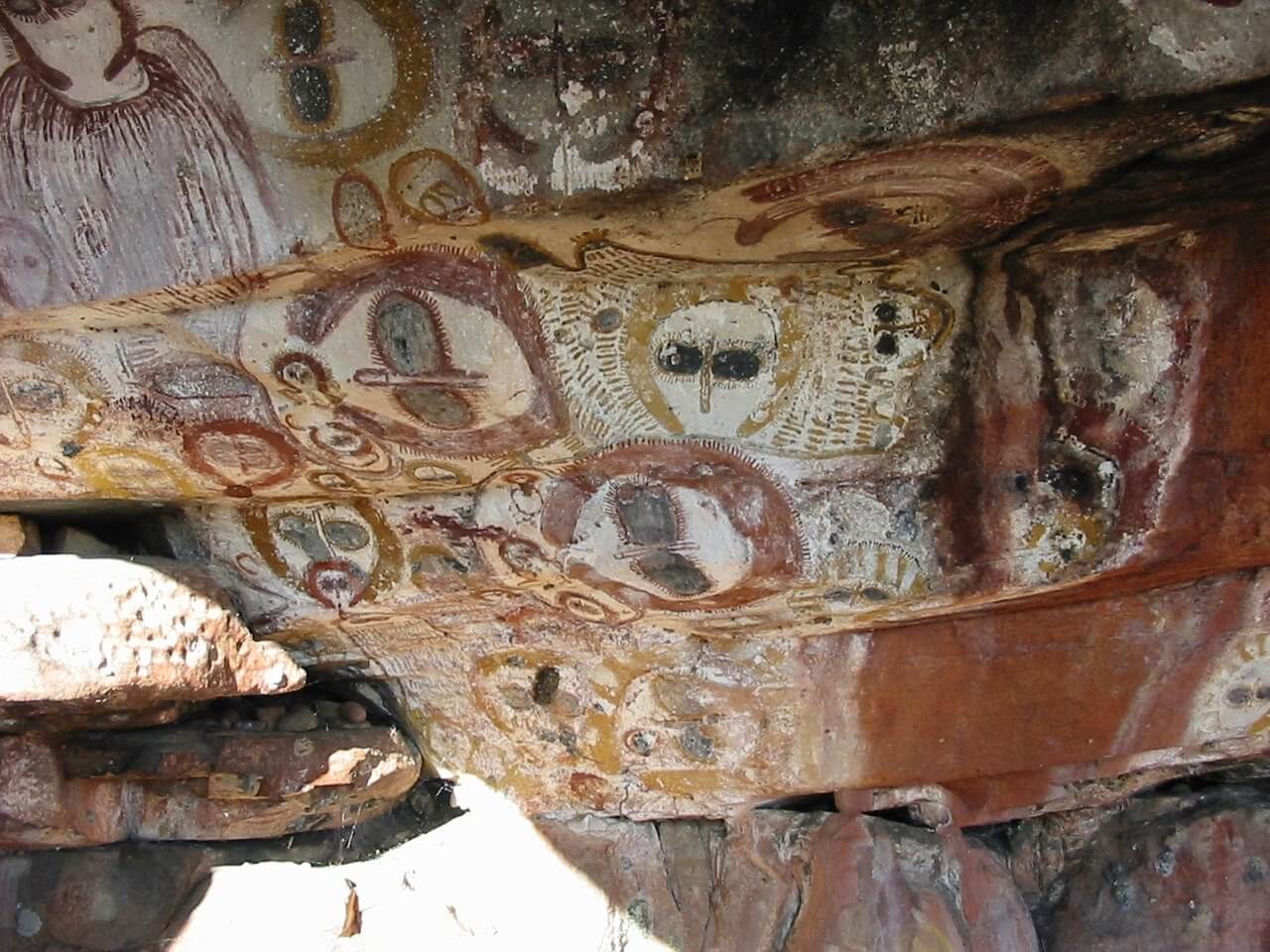
5000 year old cave art from Australia depicts strange beings that resemble what many perceive to represent the modern day 'Gray Alien.' These beings were known as Wandjina, cloud spirits and sky beings.
Ancient cave art depicting peculiar beings has been found all over the world, dating back thousands of years. Perhaps these beings weren't really mythical?
In the past century, individuals, newspapers, and military agencies have recorded thousands of UFO incidents, giving rise to much speculation about flying saucers, visitors from other planets, and alien abductions. Yet the extraterrestrial phenomenon did not begin in the present era. Far from it. The authors of Wonders in the Sky reveal a thread of vividly rendered-and sometimes strikingly similar- reports of mysterious aerial phenomena from antiquity through the modern age. These accounts often share definite physical features- such as the heat felt and described by witnesses-that have not changed much over the centuries. Indeed, such similarities between ancient and modern sightings are the rule rather than the exception.
In Wonders in the Sky, respected researchers Jacques Vallee and Chris Aubeck examine more than 500 selected reports of sightings from biblical-age antiquity through the year 1879-the point at which the Industrial Revolution deeply changed the nature of human society, and the skies began to open to airplanes, dirigibles, rockets, and other opportunities for misinterpretation represented by military prototypes. Using vivid and engaging case studies, and more than seventy-five illustrations, they reveal that unidentified flying objects have had a major impact not only on popular culture but on our history, on our religion, and on the models of the world humanity has formed from deepest antiquity.
Sure to become a classic among UFO enthusiasts and other followers of unexplained phenomena, Wonders in the Sky is the most ambitious, broad-reaching, and intelligent analysis ever written on premodern aerial mysteries.
Science: "Mysterious Australian rock art may depict the chaos following rising seas," By Elizabeth Finkel February 5th, 2020 , 2:00 PM
When lost Australian rancher Joseph Bradshaw stumbled across dancing, mulberry-colored figures painted on a rock shelter in the northwestern Kimberly region in 1891, he was mesmerized: They looked like no rock art he had seen before. Since then, the slender, detailed figures—now known as Gwions—have puzzled archaeologists, who didn’t know when they were painted or by whom. Now, scientists have used tiny specks of charcoal in fossilized wasp nests to come up with a new date for the paintings: 12,000 years ago.
“It’s fantastic,” says University of Wollongong geochronologist Richard “Bert” Roberts, who wasn’t involved in the work. Two decades ago, he used the nests to date the Gwions using a different technique; the new dates, he says, are solid. “Until now, we’ve been struggling.”
Dating the ancient works of art is hard for many reasons. The thousands of figures—which feature exquisitely detailed headdresses, tassels, boomerangs, and spears—were painted on rock shelters with mineral ochres that simply aren’t datable. Stylistically, the paintings are very different from nearby Wandjina art, characterized by spirit figures with huge dark eyes that are part of a mythology still embraced by today’s Aboriginal people. The charcoal often used for the Wanjina eyes allows for radiocarbon dating and puts the age of these paintings at up to 5000 years. But the Gwion palette did not appear to include charcoal.
ARCHAEOLOGY WORLD: "10,000 Year Old Rock Paintings Depicting Aliens And UFOs Found in India," | February 4th, 2021
Even before the great tectonic plate shift, the former central province of India, now Madhya Pradesh and Chhattisgarh, was the site of pre-agrarian human settlement. That is why a number of prehistoric cave paintings have been discovered in the region. Some of them are known to us like Bhimbetka where we mainly find cave paintings made by a hunter-gatherer population.
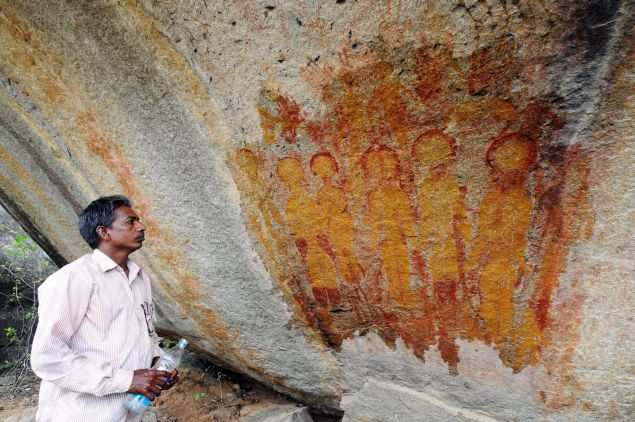
Recently in the Hoshangabad district of Madhya Pradesh, just 43 miles from the local administrative centre of Raisen, ancient 10,000-year-old rock paintings depicting UFOs and extra-terrestrials have been discovered in the caves. The caves are hidden deep within the dense jungle in Charama region in Kanker district in tribal Bastar region. Located about 130km from Raipur, the caves come under village Chandeli and Gotitola.
A few years back, a three-and-a-half- million-years- the old prehistoric human skull was discovered in the Ahthnor village of Madhya Pradesh by geologist Dr Arun Sonakia. Possibilities that the above image was drawn by those ancient humans can’t be ruled out, said Dr Sonakia.
ARCHAEOLOGY WORLD: "What is the mysterious handbag seen in Ancient Carvings across Cultures carried by the Gods?" | March 19th, 2020
What is the mysterious handbag seen in Ancient Carvings Across Cultures carried by the Gods?
Many pieces of art found on cave walls dating back to the end of the Ice Age have resembled what is known today as a handbag or purse.
The design persisted in ruins of ancient Turkish temples, Maori decorations of New Zealand, and crafts made by the Olmecs of Central America.
Subscribe to The Fedora Chronicles Stitcher, Spotify, Overcast, SoundCloud, iTunes, and PlayerFM