
9
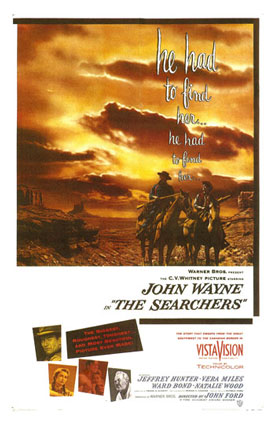
The Searchers
Release date 13th March 1956
Country: USA
Running time: 119 minutes
Genre : Western
Starring John Wayne, Jeffrey Hunter, Natalie Wood
Screenplay by Frank S Nugent
Directed by John Ford
This is a masterpiece from John Ford and the greatest Western ever made. John Wayne delivers the greatest performance of his career as Ethan Edwards the most detailed and complex character he ever played.
The film begins with a door opening and ends with a door closing; seven years of deep emotions play out in between.Wayne is an obsessed man whose perceptions are a distorted mixture of prejudice, respect, rage, fear, and love. Instead of limiting us to Wayne's point of view, however, Ford shifts the perspective, using such devices as Jeffrey Hunter's letter to Vera Miles to show different versions of the same series of events.
Still
more impressive than Ford's brilliant sense of narrative structure and
visual composition is his superb direction of actors. This is one of a
handful of sound films in which more is revealed through facial
expression, physical stance, and subtle gesture than through dialogue.
Ford further fills the gaps in our
knowledge of Wayne and Jordan's relationship through the parallel
characters of Hunter and Vera Miles. It's easy to imagine that Jordan,
too, once waited for Wayne to return, but then grew desperate for the
security she knew she'd never have with him and married his stable,
less complex brother.Wayne's
tragedy, and that of The Searchers, is that, while men of his
ruthlessness were needed to tame the West, they could not participate
in the world that resulted. Walking a thin line between savagery and
civilization, Wayne can never fully participate in one or the other.