DO YA WANNA DANCE?*DO YA WANNA DANCE?*
 In the
immortal words of Bobby Freeman, “Do Ya Wanna Dance?” Whether you attended your
prom in 1939 or 1969 or someone is taking pictures of you and your date this
May, proms have been around for generations. The fashion styles have changed,
but May is still chocked full of proms across the U.S. and the reason remains
the same, “to dress to the nines”.
In the
immortal words of Bobby Freeman, “Do Ya Wanna Dance?” Whether you attended your
prom in 1939 or 1969 or someone is taking pictures of you and your date this
May, proms have been around for generations. The fashion styles have changed,
but May is still chocked full of proms across the U.S. and the reason remains
the same, “to dress to the nines”.
 |
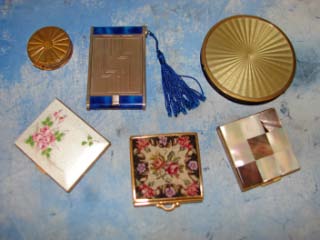 |
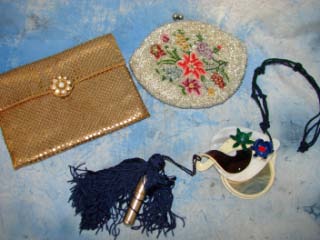
Pictured On The Left: 1920-1940’s Era prom purses - “Whiting and Davis” mesh clutch, Petite Point with beads clutch, Celluloid and Mother of Pearl compact purse. On The Right: 1920’s thru 1960’s Compacts |
|
“Prom” a shortened word for promenade was first used in 1890’s in reference to formal dances. The tradition of the formal dance held at the end of the high school academic year stemmed from the graduation ball tradition. Proms as we know them today were first held in the 1920’s and were commonplace by the 1930’s. They used to be an evening of firsts such as the first time taking the family car out after dark, the first time to dress formally and the first time attending an adult event as teenagers. School gyms across the nation became crepe papered, balloon filled illusions on a theme. To know how old I am, all you need to know is my prom’s theme song. Yes, there was a disco ball involved!
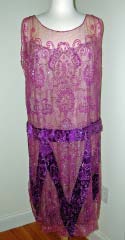
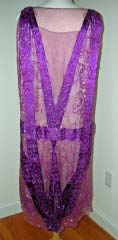 (Pictured
1920's Era Beaded Flappers Formal Gown)
(Pictured
1920's Era Beaded Flappers Formal Gown)Tradition still holds today as it did in yesteryear, that a young man would bring a corsage for his date. Depending upon the dress, the corsage would be pinned on the bodice or slipped on the wrist. His date in turn would pin a boutonnière on his lapel. The traditional corsage of a pink carnation represented “gratitude” in Victorian times. The choice of a corsage has become complicated as couples now coordinate flower color with the dress, the bowtie and or cummerbund. During the unfortunate fashion days of 1970’s the young man’s tuxedo, ruffled shirt and all, often matched the young lady’s gown.
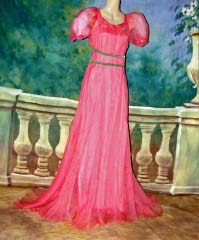 (Pictured - 1930’s Sheer pink organdy gown with matching under slip and green
velvet piping. Worn by one of the Syracuse University May Queen Court (Mother
of Syracuse High School 1963 Rose Queen yellow gown.)
(Pictured - 1930’s Sheer pink organdy gown with matching under slip and green
velvet piping. Worn by one of the Syracuse University May Queen Court (Mother
of Syracuse High School 1963 Rose Queen yellow gown.) In the early 1920’s bands were playing such songs as “Margie” (1) “Ain’t She Sweet?”(2) “Swanee” (3) and the “Charleston” (4) by 1929 “Puttin’ On the Ritz” (5) was all the rage. Jazz consider at the time “devils music” had gained solid ground in the later half of the 1920’s with hits from Louis Armstrong, Bessie Smith and many others. With an ironic twist by 1929 “Happy Days Are Here Again” (6) was topping the chart. All of this gaiety was reflected in the loose and flowing dresses worn by shebas when their dapper sheiks picked them up in their jalopies. The over-abundance of beads, sequins and fringe seems to reflect the excesses and the loosening of the moral code of the pre-depression era.
The 1930’s coming after the 1929 stock market crash saw a dramatic change in the cut of the prom dress. Bias cut gowns and dresses were all the rage, gone was the excessive beading and the pillowcase sexless style of the twenties. Dresses cut on the bias of the cloth clung to the figure as if to accentuate the seriousness and tension of the times.
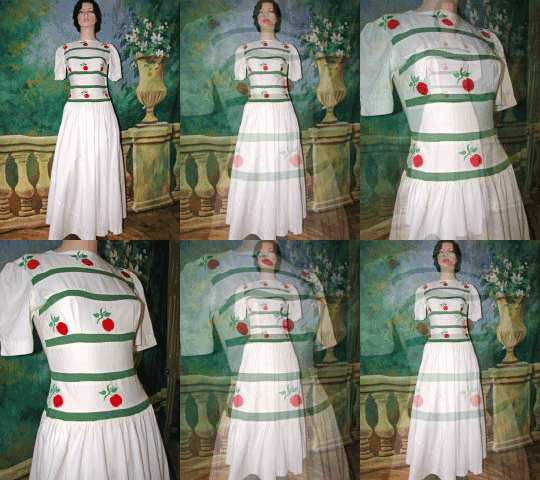 Pictured: 1940’s Era gown
made of white faille taffeta with green biase
tape striping and appliquéd apples..
Pictured: 1940’s Era gown
made of white faille taffeta with green biase
tape striping and appliquéd apples..Not only did fashion reflect the hard times of the thirties so did the music. Woody Guthrie was traveling the country singing about the displaced man in his hit song “This Land is Your Land”. Ruth Etting was singing “10 Cents a Dance” (7). Huddie Ledbetter, better known as Lead Belly, an African American singer first sang “Irene” (8) which became a perennial hit for decades. Nineteen thirty four saw the Cuban Rumba enter mainstream American dance. By 1938 Boogie Woogie was getting a lot of glamour girls and “hep” cats out on the dance floor.
 The early 1940’s prom fashion and music reflected the free wheeling days
prior to WWII with a touch of desperation. The jitterbug and the swing dance
had the kids jumping ‘n’ jiving. Glenn Miller was topping the popular charts
with such songs as “In the Mood” and “String of Pearl”. Couples were swaying to
Harry James’s “You Made Me Love You” and Wayne King’s “You Are My Sunshine”.
Shortages would soon rear their ugly head as WWII fashion had the young ladies
making due with last years fashion or making over last years dress to
incorporate narrowed hips and shoulder pads that reflected a tailored military
stature. It was considered very gauche to dress in a showy manner during a time
of shortages. WWII popular music such as “Don’t Sit under the Apple Tree with
Anyone Else but Me” (Glenn Miller), “Somebody Else is Taking My Place” (Benny
Goodman) and “There Be Bluebirds over the White Cliffs of Dover” (9) performed
by Kay Kyser all reflected the longing for a loved ones return.
The early 1940’s prom fashion and music reflected the free wheeling days
prior to WWII with a touch of desperation. The jitterbug and the swing dance
had the kids jumping ‘n’ jiving. Glenn Miller was topping the popular charts
with such songs as “In the Mood” and “String of Pearl”. Couples were swaying to
Harry James’s “You Made Me Love You” and Wayne King’s “You Are My Sunshine”.
Shortages would soon rear their ugly head as WWII fashion had the young ladies
making due with last years fashion or making over last years dress to
incorporate narrowed hips and shoulder pads that reflected a tailored military
stature. It was considered very gauche to dress in a showy manner during a time
of shortages. WWII popular music such as “Don’t Sit under the Apple Tree with
Anyone Else but Me” (Glenn Miller), “Somebody Else is Taking My Place” (Benny
Goodman) and “There Be Bluebirds over the White Cliffs of Dover” (9) performed
by Kay Kyser all reflected the longing for a loved ones return.
 |
 |
|
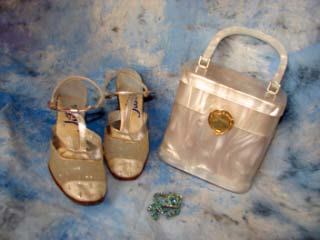
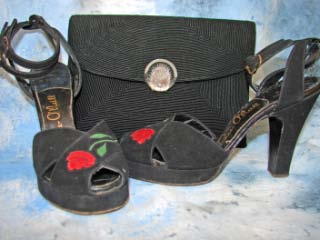
(Pictured on The Right: 1940’s corde` clutch purse and “Rose O’Neill” platform shoes. On The Left: 1950’s Era Shoes (1920’s Revival Style) 1950’s “Lucite” purse and rhinestone brooch |
||
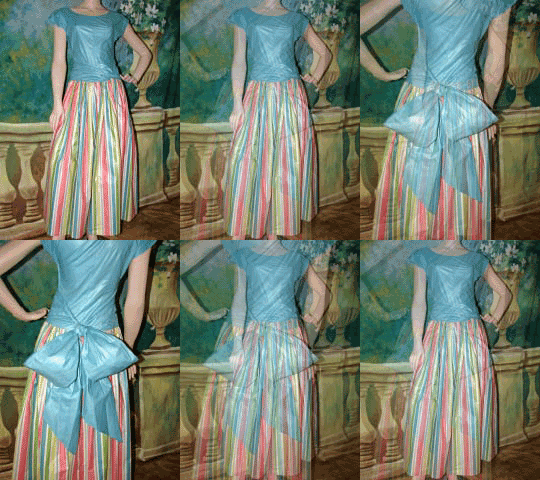
Once World War II ended, wool uniforms went into mothballs and dinner jackets came out of the closets, peplums where in vogue, as were very full skirts, even bustles made a return. Extra long hems exemplified the joy of the wars end and the end of shortages. The “greatest generation” was swinging to Frank Sinatra, Bing Crosby and even Arthur Godfrey got in to the act with his quintessential 1947 hit “Zip-A-Dee-Do-Dah”! (Pictured - Late 1940’s - Early 1950’s taffeta prom gown, Back of taffeta prom gown with slightly dropped waist and huge bow.)
 |
 |
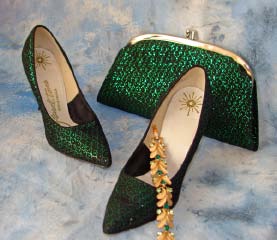 |
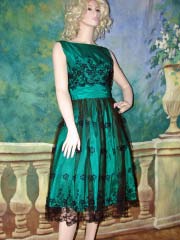
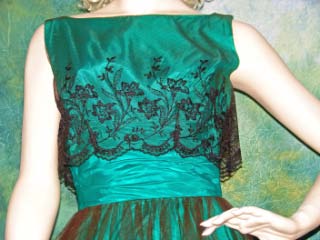
Pictured From Left To Right:1950’s Emerald green chiffon taffeta short prom dress, Bodice of 1950’s era prom dress with black lace overlay and 1960’s Sex Kitten purse and matching spike heels “Jeweltone Originals” |
||
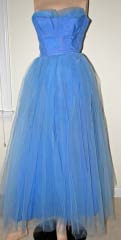 Pictured
- 1950’s Strapless gown of blue foundation net over blue taffeta.
Pictured
- 1950’s Strapless gown of blue foundation net over blue taffeta.In the early 1950, kids at the prom were getting their kicks out of dancing to Patti Page, Nat King Cole, Sammy Kaye and Pat Boone all “cool cats” in the early 1950’s. The real kick that put everyone in “fat city” came in 1955 when Bill Haley and His Comets, “Rocked Around the Clock” and it just made us want to yell for more! By 1959, no one sang it or wrote it better than Paul Anka with “Put Your Head on My Shoulder”, the perfect song for the last slow dance of the prom. Some say the music died in 1959 with the tragic death of Buddy Holly. Even if it didn't, it certainly felt like we were checking into Elvis’s “Heartbreak Hotel” (10).
With the onset of the 1960’s, before the British Invasion had us all “wigging out”, Chubby Checkers had us “Twisting” and Dion, Fabian and Kookie* were making us shimmy and shake. We danced under a “Blue Moon (11), traveled with Ricky Nelson (12), and Roy, well he just had everyone “Crying” (13). Prom fashion and fashion in general had us shortening our skirts, going strapless and grooving in yards of tulle.
 |
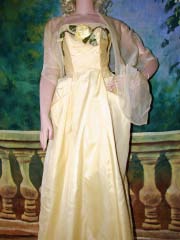 |
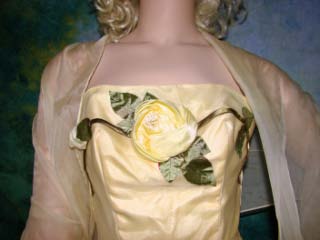
Pictured Above From Left To Right: Bodice of 1963 gown with 3 dimensional appliquéd rose, leaves and stems, 1963 Syracuse City High School Rose Queen Gown of Yellow Taffeta with matching chiffon shawl (daughter of 1930 Syracuse Un. May Queen) |
|
As prom time rolls around again this year close your eyes, take a moment because your steady might just be asking “Do Ya Wanna Dance?” (14)
Until June, this is the Girl with the Vintage Heart…Lorraine Loomis-Konig
*Kookie refers to the character played by actor Edd Byrnes in "77 Sunset Strip" (1958)
|
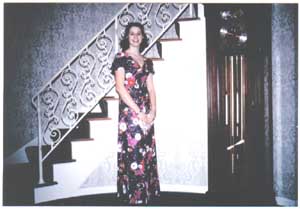
Pictured Above: Lorraine herself from her first prom... |