|
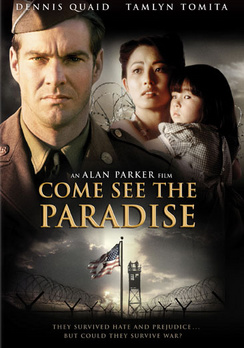
Dennis Quaid stars
as Jack McGurn, and upright idealist who is involved with the wrong
crowd in a Labor Union movement and is party to an act of arson when
the smoke bomb that's set-off in a theater gets out of control. The
protest is in behalf of projectionists hoping to have their own organization
and the plan was to scare people, not burn the theater down...
After being treated for his burns, Mr. McGurn is let go from the
Labor Union movement and is forced to leave Manhattan because we are
told via the dialog that he's too much of an idealist, a "do-gooder" AND trouble maker. He's given a few hundred bucks and
sent on his way.
Meanwhile, we're introduced to the
Kawamura family in Little Tokyo in Los Angles, California. We're
immersed in the sub-culture of the Japanese-Americans who are trying
to combine aspects of both cultures, such as the kids
doing an all-Japanese version of Shakespeare and large multi-family
gatherings that make this ethnic group enviable because of their
tight-nit nature and camaraderie. We're introduced to Lilly, the
daughter of the Kawamura's who is old enough to marry but hasn't
found the right man yet and will soon be betrothed to a friend of
her fathers who's willing to pay off Mr. Kawamura's gambling debts.
Jack McGurn is hired as the projectionist for one of Mr.
Kawamura's theaters, and he learns the language, mannerisms and
cultural aspects through the films imported from Japan. By watching the same movies over and over again
from the projection booth, he learns one of the songs sung in these
movies and we as audience members see his hard edge taken off and
learn what a charming character Mr. McGurn is and how he is able to
win Lily's heart so easliy
after their first kiss during their first chance meeting.
Lilly and Jack have a whirl-wind romance that alienates the
Kawamura family, and soon the two flee to Seattle where Jack finds
work at a fish processing plant. There are aspects to this that echo
the labor movement struggle that was featured in the Marlon Brando
classic "On The Waterfront," struggling for fairness and better
working conditions with bosses rather then union leaders.
Another protest gets out of hand and Jack winds up in jail that's
the result of getting kicked by a policeman's horse. Lilly takes
their little girl Mini back to Little Tokyo while Jack serves some
time before following them...
Fate turns a hand after Pearl Harbor and Jack is separated from
his family again as The Kawamura's are sent off to an interment camp
in some undisclosed location in the desert and he's drafted into the
armed services. He sees his family twice before being broken for
being absent with out leave and his past deeds as a labor union
protest organizer catches up with him. All the members of the
Kawamura family have their own story ark, one of Lilly's brothers
signs a paper saying that he's loyal to the United States and goes
to fight and die, while Lilly's other brother protests the
internment and is eventually repatriated to Japan - "sent back" to a
country where he's never been to before. The rest of Lilly's family
contends with issues such as conflicting loyalty, questions about
one's honor and premarital sex and pregnancy.
The family is finally reunited on a farm far from L.A.'s little
Tokyo, perhaps a metaphor for how far they've come and how far back
they've been pushed since the beginning of America's involvement in
World War II and due to the prejudice, racist and paranoid reaction
to Pearl Harbor. The ending of the motion picture and the final
reunion is both sentimental and bitter-sweet as the sun sets as the
train arrives with Jack's train arriving at the station as if to
say: "this chapter in American History is over, tomorrow hope,
liberty and justice is renewed again."
Some of us know for certain that this isn't the end, since the
Red Scare and the Communist Menace will most likely draw Jack back
into conflict because of his prior involvement with "pinko"
organizations... but that's not explored and no sequel was never
planned or filmed. Those of us who know full well what history has
in store for those people after the war. |


 While watching this movie, I was constantly reminded of the review
that I wrote for
While watching this movie, I was constantly reminded of the review
that I wrote for
 Released
in 1990
Released
in 1990 There are some genuinely winceful moments through out
this film that feels as bad as getting your eye caught on a hook.
It's hard to imagine that something like the internment of
Japanese-Americans could actually happen as we look back today. In
our era of political correctness with many special interest groups
calling foul after every breaking news story about someone doing
something bad to inmates in Guantanamo Bay - we can't imagine tens
of thousands of people being rounded up and put in cabins out in the
middle of the desert with out protest from American citizens.
There are some genuinely winceful moments through out
this film that feels as bad as getting your eye caught on a hook.
It's hard to imagine that something like the internment of
Japanese-Americans could actually happen as we look back today. In
our era of political correctness with many special interest groups
calling foul after every breaking news story about someone doing
something bad to inmates in Guantanamo Bay - we can't imagine tens
of thousands of people being rounded up and put in cabins out in the
middle of the desert with out protest from American citizens.