NASA’s GLAST Project
The telescope was assembled at Stanford Linear Accelerator Center in Menlo Park, California in 2005 and 2006 from hardware created in laboratories around the world. The Large Area Telescope will use its 880,000 silicon strips to detect high-energy gamma-rays with a resolution that, as of yet, not been seen from previous telescopes. The use of this should revolutionize both Particle Physics and Astrophysics. As it orbits the Earth, gamma-rays will strike the Large Area Telescope that are emanating from enormous black holes, pulsars, and other astronomical sources. By determining the direction the gamma-rays came from, the energy it carries and the time it arrives, the telescope will yield new data that should offer a peek into the basic nature of high-energy processes in the universe. Gamma-rays that come in contact with the telescope will first meet several layers of Tungsten metal. The Tungsten’s massive atomic nuclei interact with the high-energy gamma-rays to create a pair of highly charged particles: one electron and one positron. These particles travel in V-shaped trajectories, with the electron and positron going in different directions. These are detected the silicon strip sensors that are positioned just below each of the Tungsten layers. This will create signals that are reconstructed by algorithms to obtain the time and direction of the original gamma-ray photon.
Through this multi-step purpose, the telescope will detect gamma-ray with greater sensitivity than ever before, which will allow for detection of new energy sources and new classes of sources. In the mid 1990’s, the EGRET (Energetic Gamma Ray Experiment Telescope) made the first sky survey in high energy gamma rays with a sensitivity of up to a few giga-electron-volts of energy. This, however, proved to be insufficient to the task. The GLAST must be launched into space due to the fact that the Earth’s atmosphere blocks most of the gamma-rays needed for such study. GLAST is collaborative between NASA, the U.S. Dept. of Energy, international partners from France, Germany, Italy, Japan, and Sweden. Numerous academic institutions from the U.S. and Abroad. |
|
|
||
|
||
|
|
||
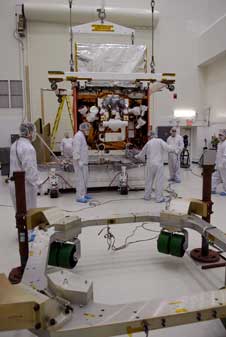 GLAST (Gamma-ray Large Area Telescope) is
scheduled to be launched into orbit on May, 16 of this year. The
creation and purpose of this telescope is to attempt to decipher how
the universe works. NASA will use this telescope to look into the
“genetic code” of the universe.
GLAST (Gamma-ray Large Area Telescope) is
scheduled to be launched into orbit on May, 16 of this year. The
creation and purpose of this telescope is to attempt to decipher how
the universe works. NASA will use this telescope to look into the
“genetic code” of the universe. After passing through the tracking layers, the
particles enter into a cesium iodide imaging calorimeter and
generate small amounts of lights with a brightness proportional to
the particles’ energies.
After passing through the tracking layers, the
particles enter into a cesium iodide imaging calorimeter and
generate small amounts of lights with a brightness proportional to
the particles’ energies.