Hubble Captures Image Of An Eruption On Tempel 1
By Bryan K. Scott
June 29th, 2005
The eruptions witnessed by the Hubble are just reminders that the
center of Tempel 1 is still very volatile and dynamic.
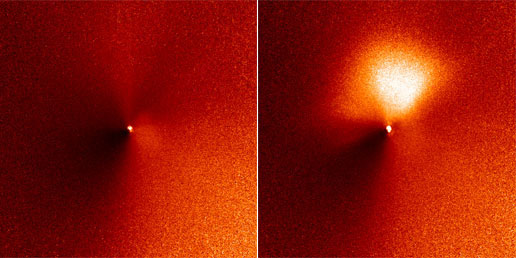
The Hubble Space Telescope, which is trained on
Tempel 1 to observe the Deep Impact mission, caught a glimpse of an
eruption on the surface of Tempel 1 on June 14th. Scientists are
now hoping that the large cloud of dust that eruption caused is just a
preview of the fireworks that they are predicting will take place on
July 4th when the impactor makes contact with the comet.
These details are a testament to the Hubble’s clear
focus on the comet which allowed them to see with exquisite detail the
comet’s temperamental activities. The Earth-orbiting observatory
was 72 million miles away from the comet when the pictures were taken.
The Deep Impact spacecraft, also, got pictures of
the eruption. Both, the Deep Impact pictures and the telescope’s
pictures, compliment each other perfectly. Though, the Hubble’s
pictures captured an image of a small star like object that was too
small for it to make out, the Deep Impact spacecraft caught nothing
unusual in the angle it captured.
The nucleus, which is roughly the shape of a potato,
is about 4 ¼ miles across and 1 ¼ miles long. At
the distance and speed the comet is traveling, the Hubble will be able
to see the impact of Deep Impact’s probe but will not be able to see
into the core of it.
Comets frequently show bursts of seismic activity
but scientists still do not know why. They theorize that it’s due
to the increased heat as it is approaching the sun that opens up a
crack in its dark, crusty exterior. This allows the dust and
gases that are trapped beneath the icy layer to escape through this
crack, forming a jet. The jet observed by the Hubble extended out
about 1320 miles from the comet’s surface. That is roughly the
distance from Copenhagen to Athens.
Scientists are hoping that the July 4th impact will
unleash even more of the primordial material that has been trapped
inside the comet for billions of years.
In Europe, The European Southern Observatory will be
conducting a massive ground-based campaign before and in the week after
the impact.
Bryan
Scott is a part time writer/columnist who comes to The Fedora
Chronicles from Oklahoma. He’s a big fan of sci-fi in general. Also
enjoys baseball, football, basketball, hockey, and soccer… As well as
anything dealing with computers and NASA. He’s the security supervisor
at a auto parts manufacturing plant. He's married with THREE beautiful
little girls…
Your thoughts? Drop us a line through our letters box.

