Dressed
To The Nines, And A Sweetheart of A Dress!Dressed
To The Nines, And A Sweetheart of A Dress!
Dressed
To The Nines, And A Sweetheart of A Dress!Dressed
To The Nines, And A Sweetheart of A Dress! What
does "Dress To The Nines" mean?
What
does "Dress To The Nines" mean?The expression “dress to the nines” has always intrigued me, enough so that I thought that I would explore in a series of nine articles where it originates from and what occasions we would be “dressed to the nines”. What does this mean and where does it come from? There seems to be an abundance of explanations as to where this expression began. One such explanation is a reference to shipping terms. Naval sailing ships had three masts each with three primary yards of sail usually not in use hence; “the whole nine yards” were fully unfurled for formal occasions or to celebrate victory at sea.* “To the nine” appears as early as 1357 in the translation of “Voyages de Jehan de Mandeville Chevalier”.
“In the 1859 “A Dictionary of Modern Slang, Cant, and Vulgar Words written by John C. Hotten “dressed up to the nines” is first cited as: “in a showy ‘recherché’ (exquisite, over refined ) manner”. Cuff links were sometimes called “nines” and many a man’s formal dress shirt had nine buttons.
My personal favorite reference has been in use for at least the last one hundred and fifty years. It is based upon a gentleman’s tailor using nine yards of material to make a man’s suit; the more material used the more the man’s status. However, nine yards does seem excessive even for the best-dressed “fop” of the day. Whatever the basis for the expression "Dressed to the Nines”, join me as I revisit the occasions for which in days gone by we would do just that!
 A
SWEETHEART OF A DRESS
A
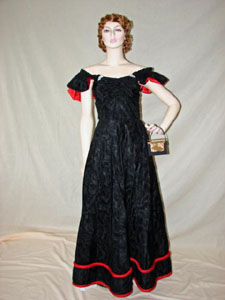
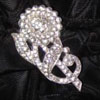
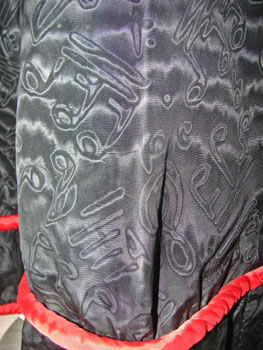
SWEETHEART OF A DRESSFebruary being the month to celebrate Valentines Day seems the perfect place to start. Valentine expressions of love have exchanged hands for centuries. Cupid would surely aim his bow at any young woman dressed in this whimsical gown swaying to Glen Miller’s “Moonlight Serenade”. The music literally comes to life in this shimmering black taffeta gown. Clef and treble notes are jumping and jiving as they weave through out the yards and yards of black taffeta. Heavy, red, faille taffeta cording gives weight to the skirt near the hemline. Valentines red peaks out at the surrounding dancers in the red taffeta lining of the gathered cap sleeves worn daringly just off the shoulder. A sweetheart neckline has been created by ruching at the center of the bodice and is accented by two rhinestone dress clips in the shape of musical notes. My model Alice further draws all eyes to her with a bezel set, rhinestone necklace and matching screw-on- earrings.
 The
sleeves are reminiscent of the mid to late 1930’s fashion as well as the
full skirt reflecting the pre-WWII abundance of fabric. An early metal side
zipper allows the lady ease of fit. At the waist, an attached self-belt
visually slims the waist as it ties simply in the back and is again
accessorized by a matching dress clip. This stunning gown will have any
woman taking center stage in this creation.
The
sleeves are reminiscent of the mid to late 1930’s fashion as well as the
full skirt reflecting the pre-WWII abundance of fabric. An early metal side
zipper allows the lady ease of fit. At the waist, an attached self-belt
visually slims the waist as it ties simply in the back and is again
accessorized by a matching dress clip. This stunning gown will have any
woman taking center stage in this creation.
A stiff, black crinoline compliments Alice’s ensemble and accentuates her positives, enhancing not only her slim waist, but also advantageously shows off her gowns fullness. Seamed silk stockings caress her legs as a garter belt of black lace holds them in place, no WWII silk shortage yet in sight.
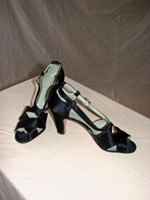 On
a recent train trip to Kansas City Alice acquired her strappy, black, silk
evening sandals, which she wears tonight from Harzfeld’s Department Store.
The crisscross ankle straps add their own sparkle with their rhinestone
buckles flashing as she rumbas her way rhythmically across the ballroom
floor.
On
a recent train trip to Kansas City Alice acquired her strappy, black, silk
evening sandals, which she wears tonight from Harzfeld’s Department Store.
The crisscross ankle straps add their own sparkle with their rhinestone
buckles flashing as she rumbas her way rhythmically across the ballroom
floor.
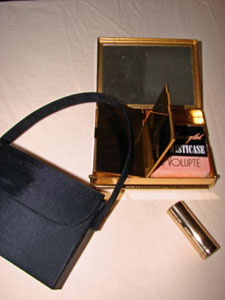
To accessorize this ensemble surely cupid would approve of this late 1930’s/40’s Volupte black compact purse. A tiny comb conveniently tucks into an outside snap pocket while the gold floral etched compact slips out and opens to reveal compartments for holding her rouge, powder, lipstick tube and mirror. Compact purses having come into fashion a decade earlier when the flappers daringly began powdering their noses and rouging their cheeks...
|
|
...Its’ handle conveniently slips over Alice’s wrist while she dances with her Valentine. It is always close at hand should the need arise to powder her nose. Tonight she will beguine** to the likes of music by Cole Porter, foxtrot to Benny Goodman and swing along with Bing. On this magic night, Hoagy Carmichael’s “Stardust” surely glistens in her eyes.
|
*The
Phrase Finder. |
|