
FREEDOM FROM WANT
Lorraine Loomis-Konig | November 18th, 2006
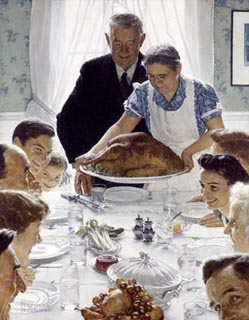 Tonight,
as I am getting ready to go to bed my head races through the list of all the
things I have to accomplish tomorrow. My mind, not ready to shut down, skips
to thoughts of what to write next for The Fedora Chronicles. I already seem
to be suffering the early onset of writer’s block. Then my mind panics at
the thought of how quickly Thanksgiving will be here. Suddenly, pushed to
the forefront of my mind is a clear picture of Norman Rockwell’s
Thanksgiving painting. Not wanting this inspiration to leave me I go and
quickly “Google” Mr. Rockwell. I discover that this particular painting is
the third installment of a four part series entitled “Four Freedoms” done
for the March 6, 1943 issue of The Saturday Evening Post magazine. This
lovely portrayal of a family sitting down to a Thanksgiving feast is
entitled “Freedom from Want”. I have to ask myself, are we freer from want
than our parents and grandparents?
Tonight,
as I am getting ready to go to bed my head races through the list of all the
things I have to accomplish tomorrow. My mind, not ready to shut down, skips
to thoughts of what to write next for The Fedora Chronicles. I already seem
to be suffering the early onset of writer’s block. Then my mind panics at
the thought of how quickly Thanksgiving will be here. Suddenly, pushed to
the forefront of my mind is a clear picture of Norman Rockwell’s
Thanksgiving painting. Not wanting this inspiration to leave me I go and
quickly “Google” Mr. Rockwell. I discover that this particular painting is
the third installment of a four part series entitled “Four Freedoms” done
for the March 6, 1943 issue of The Saturday Evening Post magazine. This
lovely portrayal of a family sitting down to a Thanksgiving feast is
entitled “Freedom from Want”. I have to ask myself, are we freer from want
than our parents and grandparents?
To me Mr. Norman Rockwell has painted the ideal picture of people just happy to be with each other. They gather together around the table, delighting in each other’s company and for a brief time they do seem free from want.
It wasn’t easy to gather together in 1943. America was deeply embroiled in WWII by this time. No doubt, there is a family member or two missing from Mr. Rockwell’s painting? Loved ones were fighting overseas and those at home sacrificed much to win the war. Shortages of every sort ruled the daily lives of most Americans. Of course, we were so lucky in the U.S. not to be on the bombing end of Hitler’s air raids, but our families sacrificed all the same. In windows all over America, small flags with gold stars represented the ultimate sacrifice of lost friends, husbands, fathers and sons. Even with all this in mind, the painting still seems to beckon to us to join them.
 In
1943 our families must have had many wants, after all rationing was in full
swing. Rationing instilled a feeling that Americans were all in the same
position, contributing to the cause of winning and bringing our boys, and in
many cases girls home. How would our family’s today react to limited
gasoline, meat, sugar, silk, shoes and nylon? I have often heard my mother
(a high school cheerleader at the time) talk of sharing rides with the
basketball players, pooling their gasoline rationing coupons to make it to
the away games. There wasn’t any extra gasoline for school activities
outside of normal school hours. Can you imagine the national maximum speed
limit called “Victory Speed” was 35 miles per hour? New tires were not
available, nor could you buy a new car. Conserving rubber was imperative as
the Japanese had seized rubber plantations in the Dutch East Indies where
ninety percent of U.S. rubber was produced. * Scrap rubber and metal drives
occurred all over the country. Americans handed in their garden hoses,
rubber shoes and even bathing caps!
In
1943 our families must have had many wants, after all rationing was in full
swing. Rationing instilled a feeling that Americans were all in the same
position, contributing to the cause of winning and bringing our boys, and in
many cases girls home. How would our family’s today react to limited
gasoline, meat, sugar, silk, shoes and nylon? I have often heard my mother
(a high school cheerleader at the time) talk of sharing rides with the
basketball players, pooling their gasoline rationing coupons to make it to
the away games. There wasn’t any extra gasoline for school activities
outside of normal school hours. Can you imagine the national maximum speed
limit called “Victory Speed” was 35 miles per hour? New tires were not
available, nor could you buy a new car. Conserving rubber was imperative as
the Japanese had seized rubber plantations in the Dutch East Indies where
ninety percent of U.S. rubber was produced. * Scrap rubber and metal drives
occurred all over the country. Americans handed in their garden hoses,
rubber shoes and even bathing caps!
Women scoured magazines for recipes that didn’t call for sugar or eggs. Homemakers planned meals with in set government limits. Publications explaining why rationing was so important to America, were numerous. Butter was rationed and Oleo was sold to be used instead. When you bought Oleo it came with a container of yellow food coloring. You needed to mix the two together so that the Oleo looked more like butter. Its’ consistency was that of a medicinal salve.
 Perhaps
the pretty young lady in Rockwell’s picture painted or drew lines up her
legs to simulate the seam of silk stockings that she could no longer buy.
The children at the table are undoubtedly dressed in cotton as it was
cheaper and could stand up to constant laundering. The older woman placing
the turkey on the table still has her apron on, waiting to remove it until
the last moment, to protect her “good dress”. Her clothes are modest in
style, perhaps even slightly outdated. People learned to “make do” with what
they had. How many of you know how to mend a pair of socks, let alone own a
darning ball? And yet I have to ask myself did that generation feel
deprived?
Perhaps
the pretty young lady in Rockwell’s picture painted or drew lines up her
legs to simulate the seam of silk stockings that she could no longer buy.
The children at the table are undoubtedly dressed in cotton as it was
cheaper and could stand up to constant laundering. The older woman placing
the turkey on the table still has her apron on, waiting to remove it until
the last moment, to protect her “good dress”. Her clothes are modest in
style, perhaps even slightly outdated. People learned to “make do” with what
they had. How many of you know how to mend a pair of socks, let alone own a
darning ball? And yet I have to ask myself did that generation feel
deprived?
In America people were actually healthier due in part to their consumption of more fresh vegetables grown in their own “Victory Gardens”. My grandparents kept chickens not only for their eggs, but meat too! They were not fed growth hormones or animal by products. They took for granted what we pay extra for today, produce that is all natural and organic. Our ancestors walked and rode their bicycles more and were thinner in general than we are today. They had no drive thru windows, fast food, or TV (let alone a remote).
Are we freer from want than people involved in their second world war? I say no. Of course, we may think that we are free from want because we seem to have everything in multiples i.e. cell phones, cars, computers etc… Our families are so busy using these conveniences that we seem to have lost touch with each other. Yes, I do know where my family is at almost any given moment, but they are in some cases hundreds of miles away. What have we lost with our freedom from want? We seem to have it all, from robotic vacuum cleaners to TiVo, but we are fast loosing the ability to stop and smell the turkey with loved ones.
Happy Thanksgiving from the girl with the vintage heart,
Lorraine Loomis-Konig