 Easter
- April, 2007
Easter
- April, 2007If ever there was a time as a child that I “dressed to the nines” it was on Easter Sunday. Much preparation was done before the actual day. Shopping for the Easter outfit that would include white wrist length gloves, a pretty pastel embroidered dress, white ankle socks with lace around the top that would be folded down to emphasize your brightly, polished patent leather “Mary Janes”*. You had to be careful when walking in these as they tended to become stuck together if they came in close proximity to one another. A skinned knee was often the result. If Easter fell early that year and there was a chill in the air, your “good” coat was needed. Your “good” coat might have been your sister’s “good” coat a few years before, but since it had only been worn for “good”, it would still have the sheen of new about it.
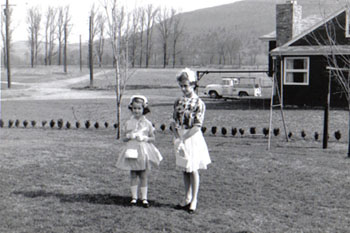 Pictured
on the left is Lorraine and her sister, both in their Easter Bonnets...
Pictured
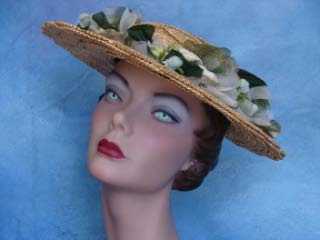
on the left is Lorraine and her sister, both in their Easter Bonnets...The final touch for any Easter outfit would be an Easter Bonnet! In my family that meant a trip to the Betty Sutton Shop** in Bath, NY was in order. Once there, little girls could find a very special straw boater perched high upon glass shelving. Its brim would be encircled with bright gross-grain ribbon. Once placed upon my head to check fit, two long streamers of ribbon would hang down my back giving me the feeling of a royal train and me a grand lady. Artificial spring flowers would surround the crown of my hat and these flowers and ribbon would coordinate with my new dress. The next year pansies or violets might show up on my new hat and some years even a whole tossed salad of flowers and greens. Once purchased, I would carry the bonnie thing home in its coordinating hatbox that denoted in pretty script the manufacturer of the hat and the store name.
The best and worse part of my new Easter Bonnet would be the elastic, chinstrap that left my chin and I vulnerable to attack by various cousins and best girl friends. After church and Sunday school, all “lady-like” decorum was left behind in the pursuit of retribution upon other chins.
 |
 |
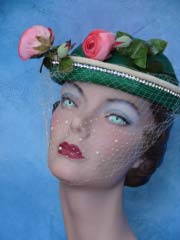 |
 In those years my Mother and her friends had their own versions of the Easter
bonnet, either a chic little Juliet cap from which feathers or ferns sprouted in
unnatural directions or later with Jackie Kennedy’s influence, the pillbox hat
with its polka dot netting tucked down under the chin. This netting left me to
ponder as I studied my Mother in church whether or not those dots caused her
eyes to cross and see two of everything.
In those years my Mother and her friends had their own versions of the Easter
bonnet, either a chic little Juliet cap from which feathers or ferns sprouted in
unnatural directions or later with Jackie Kennedy’s influence, the pillbox hat
with its polka dot netting tucked down under the chin. This netting left me to
ponder as I studied my Mother in church whether or not those dots caused her
eyes to cross and see two of everything.
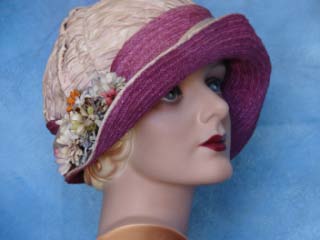
For hundreds of years women have donned these “bonnets” to frame their young and old faces as a rite of passage from winter to spring. A look through the decades as everyone dressed to the nines for Easter from my Easter bonnets of the 1950’s, back to the Edwardian woman’s huge brimmed hats shows the evolution of style dictated by the “ton” or carriage set and later by fashion designers.
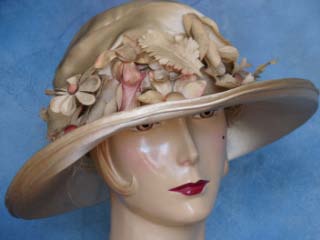
Women sick of mourning after the “war between the states” donned sprigs of flowers and encircled their heads in bright colors on the “Sunday of Joy”. In Edwardian days, the use of real stuffed birds caused the death of so many birds in the name of hat decoration that some species came near to extinction. To hold these giant monstrosities on I must mention the hatpin. Hatpins were often works of art and came in all the available materials of the day. Plain or bejeweled hatpins came in many sizes and lengths. Not only were they used to keep a hat on, but to be at the ready to remind a young man of his manners. In the name of propriety, hatpins were apparently used too often as they are now considered a lethal weapon in New York and illegal to wear.
 |
 |
|
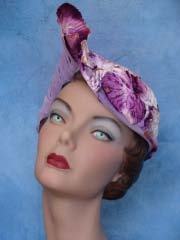
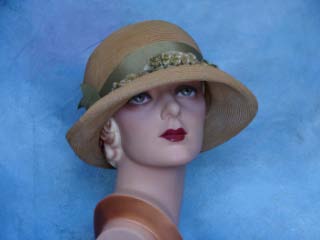
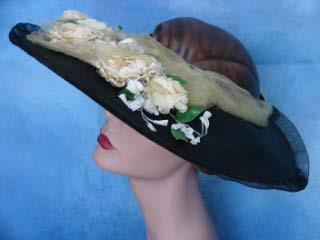
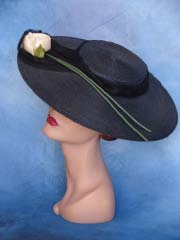
The 1920’s brought about the cloche, so dramatically ensconcing the flappers head that she could hardly see, all done in the name of liberation as women gained the right to vote and liberate their heads from coils of heavy hair cut off in the shingled or bobbed style. The 1930’s hat fashions seemed to emphasize the austere days of depression soon to be followed by the worried and weary war days of the 1940’s. Women wore “toppers” so precariously perched on their heads as to leave the mind boggled at how they stayed on. To me the toppers mirrored the insanity of the whole world for a second time at war. Hats weren’t the only thing that seemed at any moment ready to topple! |
|
 |
 |
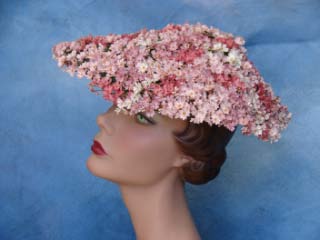
 By the 1950’s, Easter bonnets were once again expressing gaiety and optimism.
Either our Mothers’ hats were frivolous little pieces of fabric with
bric-a-brac or they were grand pancakes covered in roses, greenery or feathers,
and a swish of netting. The 1960’s came too fast and saw the death of the hat
as women had known it. Hats became a piece of netting with a tiny bow to set on
their heads when they went to church. Propriety no longer dictated that a lady
should not be seen in public without her hat and gloves, especially on Easter.
By the 1950’s, Easter bonnets were once again expressing gaiety and optimism.
Either our Mothers’ hats were frivolous little pieces of fabric with
bric-a-brac or they were grand pancakes covered in roses, greenery or feathers,
and a swish of netting. The 1960’s came too fast and saw the death of the hat
as women had known it. Hats became a piece of netting with a tiny bow to set on
their heads when they went to church. Propriety no longer dictated that a lady
should not be seen in public without her hat and gloves, especially on Easter.
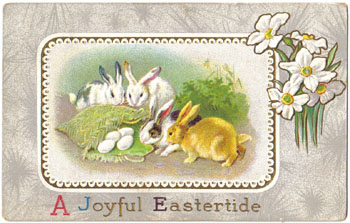
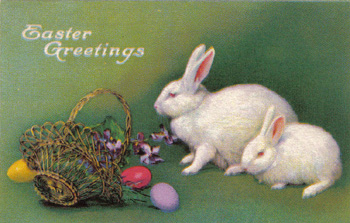
Once again, April is just around the corner and with it comes Easter bunnies, pastel colored eggs and little girls wearing lacey anklets. I wish that I could go back to the Betty Sutton shop and buy myself a new Easter Bonnet. Would it bring back the days that Irving Berlin so beautifully wrote about in his1948 song, “Easter Parade”? Would I once again, “in my Easter bonnet with all the frills upon it, feel like the grandest lady and you the proudest fellow in the Easter Parade”? Oh, to be on 5th Avenue…
 This is the girl with the vintage heart signing off and wishing you a
joyous Easter!
This is the girl with the vintage heart signing off and wishing you a
joyous Easter!
*”Easter Parade” written by Irving Berlin in 1948
**”Mary Janes” a rounded toe shoe w/low heel with a strap buckling over the instep; a character created by the Brown Shoe Company as a marketing tool
***The Betty Sutton Shop in Bath, NY no longer exists.
Please join me next month and read my two new articles. In my first, I continue my exploration of when and why we “Dressed To The Nines” as I look at the origin of the Prom. The second article for May is in honor and remembrance of my cousin Bob and all those who died in WWII during the Ploesti Oilfield Bombing Raid of 1943.
|
|
||
|
|
|
|
|
|
||