
It’s a beautiful day somewhere in the greater Southwest, and you’re in the mood for a leisurely hike in the local National Park. A favorite destination includes a winding trail that passes a group of prehistoric rock art panels, consisting both of petroglyphs and pictographs, etched into and painted onto the cliff face by Native Americans anywhere from 1,000 to 9,000 years ago. But today, as you round the bend in the trail that leads past the site, something new greets your eye. Others have visited the site since last you saw the rock art, and have left an evil legacy:
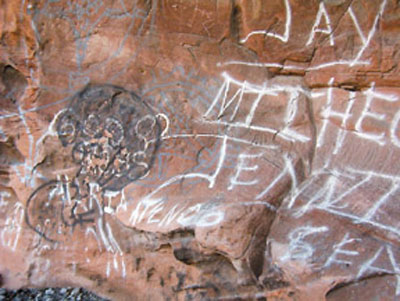
Somewhere under the paint are symbols have stood undisturbed for millennia. Symbols that had meaning to the Native Americans who carved them into the rock long before Europeans began their inexorable march across the continent, and before some thoughtless vandals with spray cans determined that their initials and names and crude sketches were more important than the legacy of a long ago people. Symbols that archaeologists have most often not deciphered, and that stand as enigmatic clues to the thoughts and practices of a people from another time and mindset.
An even worse scenario is that you round the bend in the trail not to find graffiti that may—with countless hours of work—be removed, but instead find gaping holes where entire panels have been cut from the rock face. Broken bits of stone litter the ground in front of the rocks, including shattered images that broke during the attempted removal and are discarded as worthless. You hope that the park archaeologist had the time and resources to document the site with detailed sketches, photographs, and maps, but you also know that park resources are often stretched too thin to provide adequate funds to many projects. The images under the veneer of graffiti or cut from the rock face may or may not have been properly recorded. Unfortunately many projects necessarily take precedence over archaeology, including such essential projects as fire fighting and prevention. In particular recording small sites may be indefinitely postponed due to a lack of funds or personnel or both, and sites may lie vulnerable to looters, vandals, and even well meaning but destructive visitors for years before steps can be taken to record, protect, and preserve valuable archaeological sites and resources.
This scenario is all too familiar to park rangers, archaeologists, and rock art enthusiasts all over the world. Though archaeological resources, including rock art, are protected under various pieces of legislation, particularly the Archaeological Resources Protection Act (ARPA) of 1979, the trade in stolen and looted artifacts continues almost unabated. The illegal antiquities trade is such a thriving business that it consistently ranks in the top four crimes investigated by INTERPOL each year, often second only to the illegal drug trade. Recently prosecutions have become more common, but as Federal funds continue to wane archaeological sites are becoming more vulnerable day by day. Law enforcement personnel are increasingly tasked while their numbers are cut or positions remain unfilled due to budget cuts. Dedicated groups, such as the Archaeological Conservancy, seek to fill that void and dedicate private funds to the acquisition, protection, and investigation of valuable sites all over the country. Each day they increase their holdings and protect one or more sites from being destroyed through thoughtless or malicious actions.
This knowledge, of course, is worthless as you stand and stare at the destruction wrought on the small rock art site on your favorite trail. It’s too late for this site. If the damage is graffiti, the Park Service may one day secure sufficient funds to contract a professional conservator to remove the paint and restore the rock face to as near its original state as possible. If the site has been looted, however, the damage is permanent. The best that can be hoped for is that the panels will be recovered and can be used in displays in the park’s interpretive center or museum, but in all probability they probably never will be recovered, and will grace the private collection of a single individual somewhere in the world. Chances are that no one but that individual and a few of his or her privileged friends will ever see those images again. For those panels that were destroyed during the attempted removal, nothing can be done. Those panels are irreparably damaged or completely destroyed.
As a rule, archaeological records are exempt from the Freedom of Information Act, and are protected by the agencies into whose trust they are placed. In order to protect sites to the maximum extent possible, the locations of sites are not divulged except to registered professionals; those professionals recognize the threat posed to those sites, and try to maintain the secrecy, as well. Many sites lie unnoticed except to the trained eye due to their ordinary appearance. Not many lay persons recognize the tailings of past civilizations, and walk past archaeological sites completely oblivious. Like ice bergs, the majority of the material in an archaeological site often lies buried, long after the more obvious surface material has been picked up and carried off. Rock art sites, by contrast, are highly visible sites that, more often than, not lie completely exposed. Some lie along well-used trails that have evolved into highways and byways, and are clearly visible from passing cars. Other are found deep in canyons and deep wilderness. Regardless of their location, however, once they are found they are vulnerable. Professionals and laypersons alike easily recognize them, including those that treasure the images in their original context and those that seek to profit by them or destroy them though wanton acts of vandalism. The minor protection afforded by denying access to records is lost.
As you stand and stare at the destroyed site, you wonder: What can I do? In fact, as you stand and wonder, you do not realize that you are the single most valuable element in the protection of these increasingly rare archaeological resources. Simply by recognizing the problem and harboring concern over the mindless destruction of these precious mages, you have begun the process of protecting them. How?
At a minimum tell the story of the destruction to your family and friends. Express your disgust at the actions of the vandals or looters at every opportunity. Equally important, express your disgust towards anyone who has or would even consider purchasing looted antiquities. Use your voice to alert the community to what has happened and what may happen again.
To the greatest extent possible, become involved. Volunteer. As someone who regularly hikes the trails anywhere archaeological resources are known, you are an invaluable asset to the park rangers, law enforcement personnel, and archaeologists who cannot possibly visit all of the sites under their purview on anything close to a regular basis. Carry a small notebook and record the dates you visited trails and sites, and what you saw there. Record any violations of park policy, such as littering, beer cans, and cigarette butts, and so forth. Not only are you helping the park staff with the littering problem, but the litter itself may provide valuable clues and evidence should looting or other destructive activity be discovered in the vicinity. Maintain a photographic record, too, if feasible. With the advent of digital photography, a running record of visits can be quickly and easily compiled, allowing investigators ample evidence of when an incident of vandalism or looting took place.
Talk to the rangers or law enforcement personnel, and let them know where you go and how often. They may be recalcitrant about divulging information initially, because looters often pose as researchers or avocational archaeologists to gain access to site information, but once you’ve established a relationship they will be more willing to take you into their confidence. Many parks have formal volunteer programs, and provide training in many different areas, depending on your interests and abilities. In many instances volunteers are an absolute essential part of the day-to-day operations, and their participation is highly regarded and appreciated by the regular staff.
Take some time to educate yourself on the archaeological cultures of your area. The more you learn the more adept you will become at identifying archaeological remains. You can be sure that looters who make their living by pillaging sites have spent a great deal of time learning what is valuable and what is not, and how to find sites. Sites are often only known after looters have destroyed any potential for learning anything from the site. Due to limited funds and professional personnel, the abilities of knowledgeable and vigilant volunteers to recognize sites and artifacts is often the only thing that saves a site from being looted and destroyed before it can be recorded and investigated properly.
Although vandalism is a relatively random act, looters often plan their jobs well in advance. They pay visits to the site to determine what they will need, how often the site is visited, who comes there, and how to get quickly into and out of an area. Your mere presence could prevent either a looting or an act of vandalism, by simply being able to identify an individual or a group of individuals who were at a site. Make note of whom you see at a site, at what time and on what date. Being able to isolate an incident in time is the single most valuable piece of information in the investigator’s case, and placing an individual at the scene within that time frame can often be the difference in a successful prosecution.
So if you’ve ever asked yourself what you can do to help avert the looting or vandalization of our precious rock art and other archaeological sites, the answer is: a lot! The fact is, archaeology needs you. The most effective deterrent to the vandalism and theft of our archaeological treasures is a well-informed, active group of people that value our collective history and refuse to allow the public to be robbed of the opportunity to know and learn from those resources. And the most valuable member of that team is you.
For more information on the illegal antiquities trade, please visit:
