The Hollywood Musical (1927-1932)
The
first commercial succcessful talking picture "The Jazz Singer" (1927) was
also the first film musical. Jazz era musical numbers without
sound had been staged in silent movies such as Ernst Lubitsch's
"So This Is Paris" (1926) and MGM's "The Boob" (1925) with Joan Crawford
but now the great names of Broadway and vaudeville could be heard as
well as seen.
The first great star to be heard was of course Al Jolson but his film career soon went into decline because he was cast either as a mammy's boy or a sonny boy's dad. Jolson's singing wasn't really meant for the movies, it was meant for live concerts or to make the pillars of a Broadway theatre shake without the aid of a microphone. Al also really needed an audience to make love to, that would respond to him with applause, he felt stilted singing to an empty camera lens. In 1946 though the first star of the Hollywood musical returned top centre stage with Columbia's production of "The Jolson Story" in which Larry Parks played the World's Greatest Entertainer. The film was a great success and accurately portrayed Jolson's love affair with his audiences which resulted in three broken marriages.
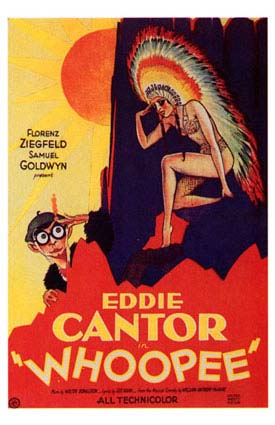
Producer Samuel Goldywn signed up another of Broadway's greatest stars Eddie Cantor for a series of musicals in the early Thirties : "Whoopee!" (1930), "Roman Scandals" (1932), "The Kid from Spain" (1932) and "Kid Millions" (1934). These films provided choreographer Busby Berkeley with a lot of his early film work.
Paramount cast the net for musical stars abroad and found Maurice Chevalier. The French boulevardier made an impact right away in his first film by singing "Every Little Breeze Seems To Whisper Louise" in the otherwise forgettable "Innocents of Paris" (1929). Chevalier was paired with Jeanette MacDonald in Ernst Lubitsch's "The Love Parade" (1929) and both stars were at their peak in Rouben Mamoulian's "Love Me Tonight" (1932) one of the finest musicals of the early Thirties. Later Jeanette MacDonald would star in a series of light operettas with Nelson Eddy at MGM where the tradition of filmed operettas continued with stars like Kathyrn Grayson and Howard Keel.
As well as borrowing Broadway stars in the early years of sound Hollywood also made primitive versions of hit musicals like "Showboat" (1929) and "The Desert Song" (1929). Two other styles of musical film first appeared in those early years : the all-star musical revue and the backstage musical.
The all-star musical revue was a convenient way of studios' showcasing talkie talents and introducing silent stars to sound. MGM produced The Hollywood Revue of 1929 which included the song "Singin' In The Rain." Universal had Bing Crosby and the Rhythm Boys in "The King of Jazz" (1930) and Warner Brothers presented their "Show of Shows" in which Rin-Tin-Tin introduced each of the acts. The standout performer in "Paramount on Parade" (1930) was Maurice Chevalier but more influential than any of these was MGM's "The Broadway Melody" (1929) which was the "putting on a show" backlstage musical. It starred Bessie Love and Anita Page and won the Academy Award for Best Picture in 1929.
Unfortunately the popularity of the movie musical declined as the Depression began to bite, people tired of the genre. By 1931 the surfeit of musicals of the preceding years had dwindled to a tiny handful.
The first great star to be heard was of course Al Jolson but his film career soon went into decline because he was cast either as a mammy's boy or a sonny boy's dad. Jolson's singing wasn't really meant for the movies, it was meant for live concerts or to make the pillars of a Broadway theatre shake without the aid of a microphone. Al also really needed an audience to make love to, that would respond to him with applause, he felt stilted singing to an empty camera lens. In 1946 though the first star of the Hollywood musical returned top centre stage with Columbia's production of "The Jolson Story" in which Larry Parks played the World's Greatest Entertainer. The film was a great success and accurately portrayed Jolson's love affair with his audiences which resulted in three broken marriages.
Producer Samuel Goldywn signed up another of Broadway's greatest stars Eddie Cantor for a series of musicals in the early Thirties : "Whoopee!" (1930), "Roman Scandals" (1932), "The Kid from Spain" (1932) and "Kid Millions" (1934). These films provided choreographer Busby Berkeley with a lot of his early film work.
Paramount cast the net for musical stars abroad and found Maurice Chevalier. The French boulevardier made an impact right away in his first film by singing "Every Little Breeze Seems To Whisper Louise" in the otherwise forgettable "Innocents of Paris" (1929). Chevalier was paired with Jeanette MacDonald in Ernst Lubitsch's "The Love Parade" (1929) and both stars were at their peak in Rouben Mamoulian's "Love Me Tonight" (1932) one of the finest musicals of the early Thirties. Later Jeanette MacDonald would star in a series of light operettas with Nelson Eddy at MGM where the tradition of filmed operettas continued with stars like Kathyrn Grayson and Howard Keel.
As well as borrowing Broadway stars in the early years of sound Hollywood also made primitive versions of hit musicals like "Showboat" (1929) and "The Desert Song" (1929). Two other styles of musical film first appeared in those early years : the all-star musical revue and the backstage musical.
The all-star musical revue was a convenient way of studios' showcasing talkie talents and introducing silent stars to sound. MGM produced The Hollywood Revue of 1929 which included the song "Singin' In The Rain." Universal had Bing Crosby and the Rhythm Boys in "The King of Jazz" (1930) and Warner Brothers presented their "Show of Shows" in which Rin-Tin-Tin introduced each of the acts. The standout performer in "Paramount on Parade" (1930) was Maurice Chevalier but more influential than any of these was MGM's "The Broadway Melody" (1929) which was the "putting on a show" backlstage musical. It starred Bessie Love and Anita Page and won the Academy Award for Best Picture in 1929.
Unfortunately the popularity of the movie musical declined as the Depression began to bite, people tired of the genre. By 1931 the surfeit of musicals of the preceding years had dwindled to a tiny handful.