The Lumiere Brothers and the Birth of Cinema

"Wave
after wave came tumbling onto the sands and as they struck broke into
little floods just like the real thing, some of the people in the front
rows seemed to be afraid they were going to get wet and looked about to
see where they could run to in case the waves came too close."
This was the reaction of the New York Dramatic Mirror to an early performance of movies projected onto a screen in the USA at Koster and Bial's Music Hall on April 23rd 1896.
The communal experience of cinema is around 110 years old but moving images are much older than that. Plays conjured by shadows have been around since Stone Age man discovered the secret of fire. A huge step forward was the invention of the magic lantern in about 1660. By the 1700s the pictures created by the lantern were starting to move. Shows were on a modest scale at first because of a lack of light in an era before the invention of the electric light bulb. This however could be often be used to the showman's advantage. One of the most popular types of lantern show was the phantasmagoria which plunged the audience into darkness and used back projection to suggest caves populated by ghosts and skeletons. This further induced mightmatres with noises of thunder and flashes of lightning.
New sources of illumination in the 19th century like limelight dramatically increased the effectiveness of lantern shows. Photography aided the telling of stories. After 1880 story slides were often posed photographs which when seen today can easily be mistaken for early motion pictures. Story slides used sets, props, actors and actresses just like movies. A narrator related the plot to the audience. Alexander Black invented what he described as the slow movie in which four slides a minute dissolved together onto the screen. An example of this was Black's Picture play of 1894 Miss Jerry which was a huge success in the period between the invention of the motion picture and its projection onto a screen.
Discoveries about how the human eye perceived motion led to the manufacture of a variety of stroboscopic devices which simulated movement. Although the cinema has been perceived as the invention of American Thomas Alva Edison European inventors like Britain's William Friese Greene, Germany's Anschutz and Schaldanowski and France's Georges Demeny made important contributions to the development of the cinematic apparatus. Friese Greene died at a film congress in 1921 with less than two shillings in his pocket. Robert Donat played Friese Greene in the 1951 film The Magic Box .
Edison's Kinetoscope of 1892 was a simple slot machine. Dropping a coin in a slot gave life to a tiny picture. Edison built the first motion picture studio in the back garden of his laboratory. This revolving prefabricated building was like a police patrol wagon and was nicknamed The Black Maria. It was here Fred Ott filmed his famous sneeze one of the first short joke films produced in 1893 for the Kinetoscope parlours.
The experience of the Kinetoscope was an individual one. The cinema only really began when an audience sat in the dark watching those moving images projected onto a screen. In the USA the movies were to remain almost entirely in the slot machine parlours until 1905.
In France the Lumiere brothers were pointing the way to the future. Auguste and Louis Lumiere opened a public auditorium in Paris for the exhibition of motion pictures on 28th December 1895. It was in the basement of the Grand cafe on the Boulevard de Campucines which was exotically decorated like many a future picture palace. During the first few days there was little interest but soon the shows captured the public's imagination and within a few weeks the cinematograph was a worldwide success.

Workers leaving the Lumiere Factory 1895
Anticipating this success the Lumieres had shrewdly built up their stock of projectors and had trained an army of cameramen who both shot and projected films all over the world. The result of this was within a few years they had access to an incredible total of 1200 short films including one which captured Queen Victoria's Diamond Jubilee procession in 1897.
During 1896 the Lumieres introduced this new wonder of the age the cinematograph to all the major cities of the world. In February they opened in London. In April there were presentations in Vienna and Genoa. The cinematograph was demonstrated in Madrid, Belgrade and New York in June.In the second half of 1896 countries as diverse and far apart as Russia, Egypt, Japan, India and Australia experienced the communal nature of cinema for the first time. The world was suddennly a smaller and less complicated place as the cinema transcended barriers of language and national customs. The invention of the motor car and wireless telegraphy also contributed to this new global perspective but the impact of the cinema on international communication cannot be overrated.
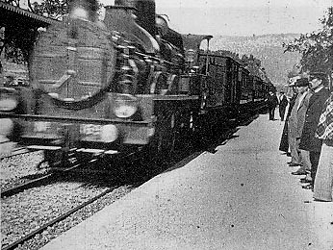
Arrival of a train 1895
This was the reaction of the New York Dramatic Mirror to an early performance of movies projected onto a screen in the USA at Koster and Bial's Music Hall on April 23rd 1896.
The communal experience of cinema is around 110 years old but moving images are much older than that. Plays conjured by shadows have been around since Stone Age man discovered the secret of fire. A huge step forward was the invention of the magic lantern in about 1660. By the 1700s the pictures created by the lantern were starting to move. Shows were on a modest scale at first because of a lack of light in an era before the invention of the electric light bulb. This however could be often be used to the showman's advantage. One of the most popular types of lantern show was the phantasmagoria which plunged the audience into darkness and used back projection to suggest caves populated by ghosts and skeletons. This further induced mightmatres with noises of thunder and flashes of lightning.
New sources of illumination in the 19th century like limelight dramatically increased the effectiveness of lantern shows. Photography aided the telling of stories. After 1880 story slides were often posed photographs which when seen today can easily be mistaken for early motion pictures. Story slides used sets, props, actors and actresses just like movies. A narrator related the plot to the audience. Alexander Black invented what he described as the slow movie in which four slides a minute dissolved together onto the screen. An example of this was Black's Picture play of 1894 Miss Jerry which was a huge success in the period between the invention of the motion picture and its projection onto a screen.
Discoveries about how the human eye perceived motion led to the manufacture of a variety of stroboscopic devices which simulated movement. Although the cinema has been perceived as the invention of American Thomas Alva Edison European inventors like Britain's William Friese Greene, Germany's Anschutz and Schaldanowski and France's Georges Demeny made important contributions to the development of the cinematic apparatus. Friese Greene died at a film congress in 1921 with less than two shillings in his pocket. Robert Donat played Friese Greene in the 1951 film The Magic Box .
Edison's Kinetoscope of 1892 was a simple slot machine. Dropping a coin in a slot gave life to a tiny picture. Edison built the first motion picture studio in the back garden of his laboratory. This revolving prefabricated building was like a police patrol wagon and was nicknamed The Black Maria. It was here Fred Ott filmed his famous sneeze one of the first short joke films produced in 1893 for the Kinetoscope parlours.
The experience of the Kinetoscope was an individual one. The cinema only really began when an audience sat in the dark watching those moving images projected onto a screen. In the USA the movies were to remain almost entirely in the slot machine parlours until 1905.
In France the Lumiere brothers were pointing the way to the future. Auguste and Louis Lumiere opened a public auditorium in Paris for the exhibition of motion pictures on 28th December 1895. It was in the basement of the Grand cafe on the Boulevard de Campucines which was exotically decorated like many a future picture palace. During the first few days there was little interest but soon the shows captured the public's imagination and within a few weeks the cinematograph was a worldwide success.
Workers leaving the Lumiere Factory 1895
Anticipating this success the Lumieres had shrewdly built up their stock of projectors and had trained an army of cameramen who both shot and projected films all over the world. The result of this was within a few years they had access to an incredible total of 1200 short films including one which captured Queen Victoria's Diamond Jubilee procession in 1897.
During 1896 the Lumieres introduced this new wonder of the age the cinematograph to all the major cities of the world. In February they opened in London. In April there were presentations in Vienna and Genoa. The cinematograph was demonstrated in Madrid, Belgrade and New York in June.In the second half of 1896 countries as diverse and far apart as Russia, Egypt, Japan, India and Australia experienced the communal nature of cinema for the first time. The world was suddennly a smaller and less complicated place as the cinema transcended barriers of language and national customs. The invention of the motor car and wireless telegraphy also contributed to this new global perspective but the impact of the cinema on international communication cannot be overrated.
Arrival of a train 1895
The Lumieres eventually tired of being showmen and sold the rights to their camera to Charles Pathe in 1900. For the next thirty years Louis Lumiere experimented with the idea of a giant screen which would encircle the audience. He also made a contribution to the development of colour plate photography but he had little interest in the movies as a form of entertainment. Louis Lumiere died in 1948. Like Edison the Lumieres viewed the movies as a novelty which would soon be replaced by another craze. They failed to envisage that the cinema would eventually emerge from his early novelty years and become the greatest provider of quality entertainment the world has ever seen.

Written content copyright Derek McLellan,2005.
Copyright © The Fedora Chronicles
Lumiere images from
http://www.acmi.net.au