Alfred Hitchcock (1899 - 1980)
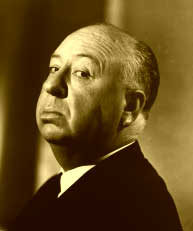
Early in his career Hitchcock made films
in other genres but he generally followed the same suspense thriller
formula. His films are very cinematic in their foundation on visuals
and remain very entertaining because he made movies for the audience.
Hitchcock's first suspense thriller was The Lodger (1926) with Ivor Novello as an innocent man wrongly accused, a theme running through his work. He showed how sound could add suspense to the thriller with Blackmail (1929) but his best British films were made in the mid 30s for Gaumont British and the producer Michael Balcon. There was The Man Who Knew Too Much (1934) which he was to remake in colour and widescreen twenty years later. Even better is the finest screen version of The 39 Steps (1935) starring Robert Donat and Madeleine Carroll escaping from enemy agents handcuffed together on the Scottish moors.
This film along with Young and Innocent (1937) and The Lady Vanishes (1938) starring Margaret Lockwood led to the independent producer David O' Selznick inviting Hitchcock to Hollywood.
The master of suspense started his Hollywood career well with an adaptation of Daphne du Maurier's Rebecca (1940) which starred Laurence Olivier and Joan Fontaine. This was the only one of his films to win a Best Picture Oscar, Hitchcock was nominated a few times as Best Director but never won.
The sinister intrusion of a beloved uncle who turns out to be a murderer in a typical American small town was the theme of Shadow of a Doubt (1943). Spellbound (1945) was a dark study of psychoanalysis with designs by Salvador Dali. Claude Rains was a Nazi sympathiser and Cary Grant an American spy in Notorious (1946).
In Strangers On a Train (1951) Bruno Anthony, the character played by Robert Walker is Guy Haines (Farley Grainger) evil alter ego doing something murdering someone (Guy's tiresome wife) Guy wants to do but can't because of his belief in right and justice. Bruno is unfettered by that belief. As mother fixated Norman Bates is in Psycho (1960) Hitchcock's ultimate study of a psychopath.
Despite his much publicised, scathing attitude towards actors Hitchcock provided them with great opportunities. In his peak period he made great use of Cary Grant, James Stewart and Grace Kelly. Hitchcock revealed how sinister Grant could be in Suspicion (1942) but the actor's finest film for him was the chase compendium North by Northwest (1959). James Stewart was at his best restricted to his chair looking out of his rear window in the film of the same name and showed incredible depth to his acting ability in the psychologically complex Vertigo (1958).
Hitch's last great film was The Birds (1963) which some critics complained lacked a satisfactory ending. His later films were disappointing though the rather grisly Frenzy (1972) was quite successful and recalled The Lodger (1926) with its London setting.
Hitchcock's first suspense thriller was The Lodger (1926) with Ivor Novello as an innocent man wrongly accused, a theme running through his work. He showed how sound could add suspense to the thriller with Blackmail (1929) but his best British films were made in the mid 30s for Gaumont British and the producer Michael Balcon. There was The Man Who Knew Too Much (1934) which he was to remake in colour and widescreen twenty years later. Even better is the finest screen version of The 39 Steps (1935) starring Robert Donat and Madeleine Carroll escaping from enemy agents handcuffed together on the Scottish moors.
This film along with Young and Innocent (1937) and The Lady Vanishes (1938) starring Margaret Lockwood led to the independent producer David O' Selznick inviting Hitchcock to Hollywood.
The master of suspense started his Hollywood career well with an adaptation of Daphne du Maurier's Rebecca (1940) which starred Laurence Olivier and Joan Fontaine. This was the only one of his films to win a Best Picture Oscar, Hitchcock was nominated a few times as Best Director but never won.
The sinister intrusion of a beloved uncle who turns out to be a murderer in a typical American small town was the theme of Shadow of a Doubt (1943). Spellbound (1945) was a dark study of psychoanalysis with designs by Salvador Dali. Claude Rains was a Nazi sympathiser and Cary Grant an American spy in Notorious (1946).
In Strangers On a Train (1951) Bruno Anthony, the character played by Robert Walker is Guy Haines (Farley Grainger) evil alter ego doing something murdering someone (Guy's tiresome wife) Guy wants to do but can't because of his belief in right and justice. Bruno is unfettered by that belief. As mother fixated Norman Bates is in Psycho (1960) Hitchcock's ultimate study of a psychopath.
Despite his much publicised, scathing attitude towards actors Hitchcock provided them with great opportunities. In his peak period he made great use of Cary Grant, James Stewart and Grace Kelly. Hitchcock revealed how sinister Grant could be in Suspicion (1942) but the actor's finest film for him was the chase compendium North by Northwest (1959). James Stewart was at his best restricted to his chair looking out of his rear window in the film of the same name and showed incredible depth to his acting ability in the psychologically complex Vertigo (1958).
Hitch's last great film was The Birds (1963) which some critics complained lacked a satisfactory ending. His later films were disappointing though the rather grisly Frenzy (1972) was quite successful and recalled The Lodger (1926) with its London setting.

Written content copyright Derek McLellan,2005.
Copyright © The Fedora Chronicles
Alfred Hitchcock image from
http://www.4to40.com/legends/index.asp?article=legends_alfredhitchcock