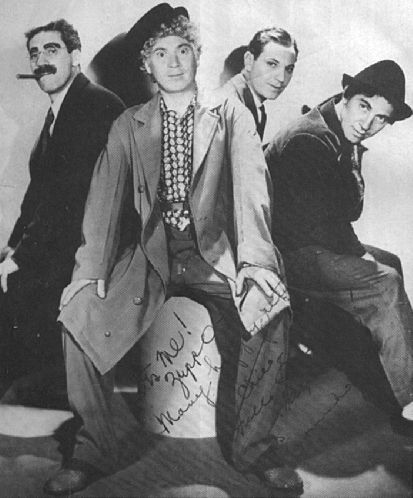
The Marx Brothers
Groucho (1890 - 1977) Harpo (1888 - 1964)
Chico (1886 - 1961) Zeppo (1901 - 1979)
As far as crazy comedy goes The Marx
Brothers set the standards. They were a Jewish troupe of vaudevillians
who found immortality in the movies by utilising the full potential of
sound with their wisecracking style, at its best their comedy was
viewed as highly literate with incredible routines which haven't dated
or been surpassed in their originality or brilliance. The visual side
to their comedy was important too, Harpo was a great mime whose wild
antics in the early films made him seem dangerous and not really a true
human being but audiences loved him.
Harpo in real life was loved by everyone who knew him as a considerate soul. Groucho had the same sharp tongue we see onscreen and drove a few wives to drink with his behaviour, he was very lonely and had bouts of depression or insomnia after losing a lot of money in the Wall Street Crash of 1929. Chico was a womanising gambler but very good with business often representing the Brothers in negotiations with movie studios, it was he who introduced them to Irving Thalberg from MGM. Zeppo, the youngest brother was considered the funniest offscreen but played a bland, juvenile straight man onscreen.
The Marx Brothers' first two films The Cocoanuts (1929) and Animal Crackers (1930) based on their hit Broadway shows were made at New York's Astoria Studios so they could go from filming by day and appearing on Broadway at night. Both films suffer from being creaky early talkies but the second is much more polished and features many great routines.
Going to Hollywood the brothers embarked on their three craziest films : Monkey Business (1931), Horse Feathers (1932) and the sublime Duck Soup (1933). All three were reasonably successful despite myths to the contrary but the brothers fell out with Paramount and for a time considered making a film version of the Gershwins' Broadway show Of Thee I Sing, though nothing came of this it meant it was inevitable that Duck Soup (1933) would be their last Paramount film.
Moving to MGM the harder edges of the Brothers' crazy comedy were softened. The romantic leads were more integral to the plots and took up more of the running time still they managed to make two good films for MGM : A Night at the Opera (1935) and A Day at the Races (1937). Sadly the producer Irving Thalberg died and without him the Marx Brothers' films were reduced to second feature status though even the later MGMs have their moments though they are hard to come by in the last The Big Store (1941).
The brothers were back in not bad form in A Night in Casablanca (1946), but a further reunion in Love Happy (1949) was not a success. Only Groucho was really able to make a huge career on his own mainly of the back of the radio and TV quiz show You Bet Your Life.
The Marx Brothers only made 12 films not including Love Happy (1949) which was more a Harpo solo vehicle but overall it was a triumph of quality over quantity, even their weakest films like so many of the comedy greats are enlivened by their very presence.

Harpo in real life was loved by everyone who knew him as a considerate soul. Groucho had the same sharp tongue we see onscreen and drove a few wives to drink with his behaviour, he was very lonely and had bouts of depression or insomnia after losing a lot of money in the Wall Street Crash of 1929. Chico was a womanising gambler but very good with business often representing the Brothers in negotiations with movie studios, it was he who introduced them to Irving Thalberg from MGM. Zeppo, the youngest brother was considered the funniest offscreen but played a bland, juvenile straight man onscreen.
The Marx Brothers' first two films The Cocoanuts (1929) and Animal Crackers (1930) based on their hit Broadway shows were made at New York's Astoria Studios so they could go from filming by day and appearing on Broadway at night. Both films suffer from being creaky early talkies but the second is much more polished and features many great routines.
Going to Hollywood the brothers embarked on their three craziest films : Monkey Business (1931), Horse Feathers (1932) and the sublime Duck Soup (1933). All three were reasonably successful despite myths to the contrary but the brothers fell out with Paramount and for a time considered making a film version of the Gershwins' Broadway show Of Thee I Sing, though nothing came of this it meant it was inevitable that Duck Soup (1933) would be their last Paramount film.
Moving to MGM the harder edges of the Brothers' crazy comedy were softened. The romantic leads were more integral to the plots and took up more of the running time still they managed to make two good films for MGM : A Night at the Opera (1935) and A Day at the Races (1937). Sadly the producer Irving Thalberg died and without him the Marx Brothers' films were reduced to second feature status though even the later MGMs have their moments though they are hard to come by in the last The Big Store (1941).
The brothers were back in not bad form in A Night in Casablanca (1946), but a further reunion in Love Happy (1949) was not a success. Only Groucho was really able to make a huge career on his own mainly of the back of the radio and TV quiz show You Bet Your Life.
The Marx Brothers only made 12 films not including Love Happy (1949) which was more a Harpo solo vehicle but overall it was a triumph of quality over quantity, even their weakest films like so many of the comedy greats are enlivened by their very presence.
Written content copyright Derek McLellan,2005.
Copyright © The Fedora Chronicles
Marx Brothers Image from
http://www.richmondhillhistory.org/marxbrothers.html